I’ve been busy painting, exploring a peculiar new twist on watercolors… I am using whiskey in place of water! I call these artworks whiskey-colors. This is not my unique idea; it is a technique heralded and practiced by an art group called the Whiskey Painters of America. More about that organization below - let’s get onto the fun part.
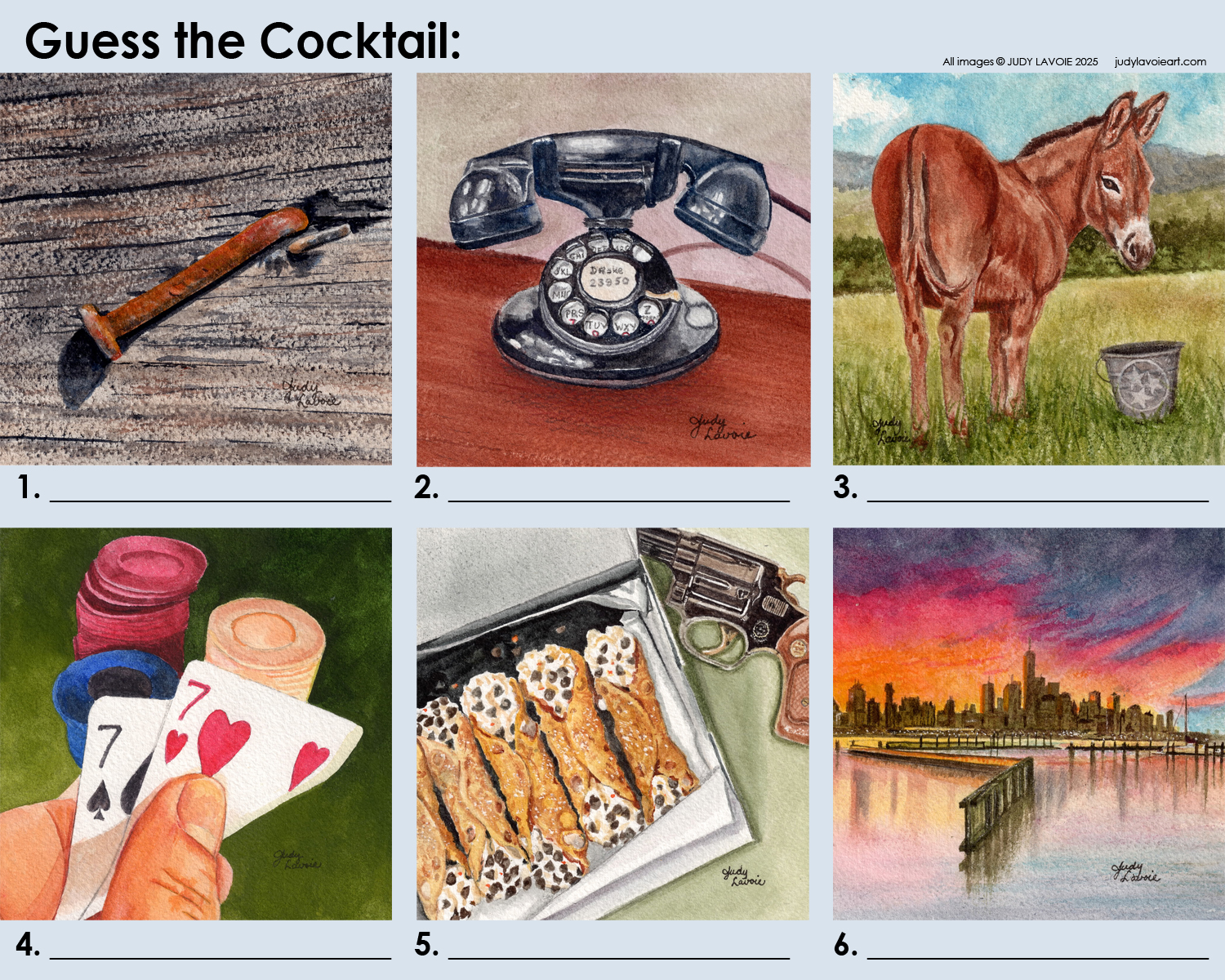
Shown here are my series of six whiskey-color paintings. I painted each to represent the name of a popular cocktail made with whiskey. I chose images which I hope will make your first thought evoke the actual name of the cocktail it represents. For example, if I was depicting a Sombrero cocktail (made with coffee liqueur and milk), I could paint a Mexican straw hat to make the viewer think Sombrero. It’s that simple, but the guesswork might be challenging if, like me, you are not a cocktail fan or a bartender! I would not be able to guess them if I hadn’t researched whiskey cocktails. Take the quiz just for fun, looking at each painting and making a guess. The answers are at the bottom of this post.
Learning that some watercolor artists dilute their paints with whiskey amused me. I wanted to give it a try, just for something new and different. The thought of doing a series of little paintings with images that relate to whiskey itself popped into mind. I know just a little about liquor, so I began by searching online for names of popular whiskey cocktails. I made a short list of those I thought could be captured with a painted scene or object. I eliminated ones which gave me no visual inspiration, like Mint Julep and Whiskey Sour. I ran my list by two former bartenders, my sister Jean and my friend Teresa, and fine-tuned my list to six possible paintings, based on their helpful feedback.
Coming up with simple images was a challenge, and for most of these paintings I explored several possibilities. I set up my own arrangements and photographed them (one is shown here), visited a local museum and other nearby spots to take pictures, and scouted online for free usage reference photos. I used Photoshop to size, crop and combine reference images, incorporating elements of design which I try to incorporate for every painting, like balance, range of values, textures, color harmony, etc. After checking the ingredients used for the cocktails I chose, I painted each with the type of whiskey most commonly used, such as whiskey, rye, scotch, or bourbon. I ended up creating 7 paintings - I was unhappy with one I had struggled with and painted a new version which I liked better.
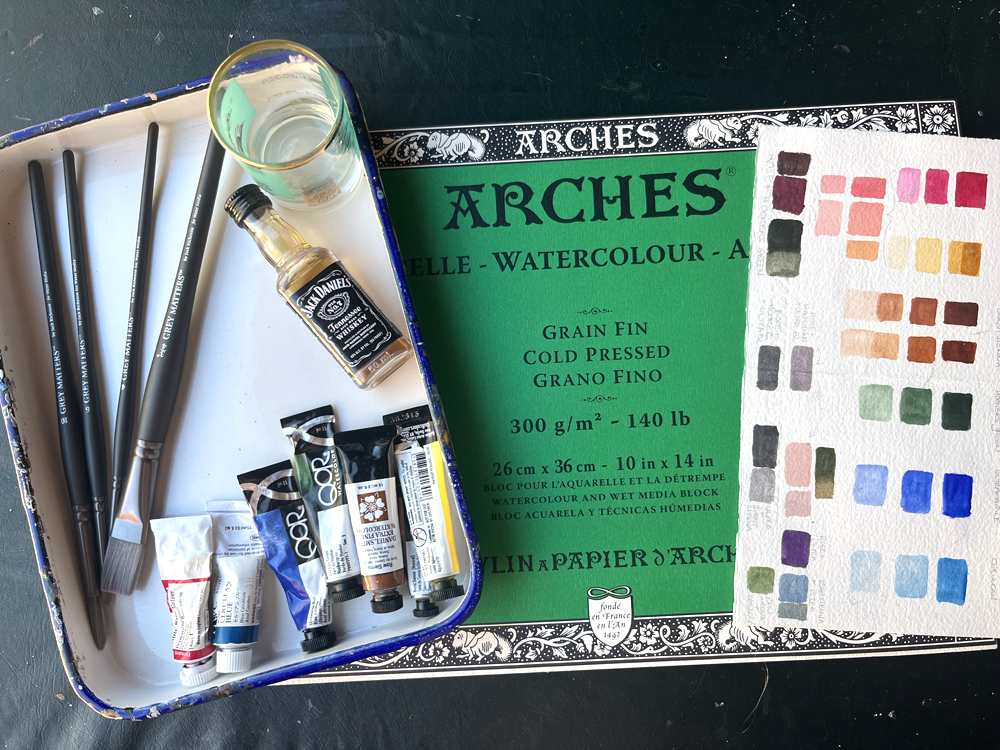
Technically, the six paintings shown are each 4” x 4”, painted with a limited color palette. I used an Arches block of 140lb. cold press 10” x 14” papers, creating 2 paintings on each sheet. The colors are a selection used by an artist whose work I love, Mary Whyte. They include various brands, with raw sienna, burnt sienna, permanent rose, hookers green, cerulean blue, ultramarine. I added cadmium yellow to give me another strong primary for better mixing of colors. As with various limited palettes I use, I refer to a sheet I created with test swatches as a guide. This shows me tints of each color as well as some mixtures to create other colors, such as purple or grey. I lay out a small amount of paint in a white porcelain tray and mix my colors there as needed. Also shown in the photo is a 2oz. shot glass to hold the small amount of whiskey I paint with and a nip of Tennessee’s own Jack Daniels. For this series I used a set of water media brushes I had won, called Grey Masters™ by Jack Richeson. Included were #2, 4, 6 and 10 pointed and a 3/4” flat. I liked working with them.
All About Whiskey
I’m no authority on whiskey (and prefer wine or hard cider when imbibing), but I have learned more with this exercise. Whiskeys vary, due to many factors. Different grains are used, such as barley, wheat, corn or rye, and there many methods for every step of production: mashing, fermenting, distilling, aging, diluting, blending, flavoring, coloring and more. The source of ingredients and place of distilling make a difference as well as the alcohol content. Aging can occur in new oak barrels, white oak barrels, charred barrels, or barrels soaked in wine or sherry. Traditions, regional standards, and even trade legislation are other factors, such as bourbon being required to be made with a grain mixture of at least 51% corn, or everything called scotch being made only in Scotland. Cocktails generally are not made with the finest spirits; those are commonly reserved for sipping neat or on the rocks. Now I understand why there are so many different whiskeys and why people have their preferred ones.
The Whiskey Painters of America
My introduction to the Whiskey Painters of America (WPA) was a few years ago. I was reading the credentials of an artist and listed among awards and designations was membership in the WPA. Their website provides an interesting history. Based on the work of the founder Joe Ferriot, member artists create miniature paintings (now specified to be no larger than 5”x4”), thinning their paint with alcoholic spirits. “On a foggy night in 1962 at the Tangier Night Club in Akron, Ohio, 11 members convened, forming a charter with by-laws and governing rules, and elected Joe as president.” The exclusive group allows no more than 150 living members, and those wanting to join must be sponsored by an existing member, then go through a jury process. The WPA holds four exhibitions and sales shows each year. While doing this series of cocktail paintings, I made contact with the current president, inquiring about how to find a sponsor and go through the jurying process. I learned they currently have openings for new members. I also received a positive response about joining and the president found a member sponsor who has contacted me. He said "...clearly you qualify the basic requirements, ie; having won awards and quality of work." With my membership application, I must submit two paintings which meet their specifications. If/when I am accepted, one will become part of the WPA's permanent collection and the second is awarded to my sponsor. I am on my way to becoming an official Whiskey Painter!
Cocktail Quiz Answers
- Rusty Nail, a cocktail made with Scotch and Drambuie
- painted with The Famous Grouse Blended Scotch
INSPIRATION: This cocktail name was the first to conjure an image, maybe because I live in a rural area full of old barns and fenceposts. It didn’t take me long to find many rusty old nails!
REFERENCE: My photo of a rusty nail on an old cedar fence post bordering a pasture adjacent to my driveway. - Old Fashioned, a cocktail made with Bourbon, bitters, sugar and water
- painted with Maker’s Mark Kentucky Bourbon
INSPIRATION: I could think of many items that are “old-fashioned” like the antique autos and trucks I have painted, old sewing machines, etc. Phones topped my list, with everyone everywhere so attached to their cell phones and younger generations never using a phone with a rotary dial. For my reference photo I merely needed to tour around a museum just a few miles from home.
REFERENCE: Old telephone photographed at the Charles Hall Museum, Tellico Plains TN. Mr Hall (1924-2015) was owner and operator of the Tellico Telephone Company from 1954-1972, and mayor of my hometown for 31 years. In 2002 he built the first building of the Charles Hall Museum to house his enormous lifelong collections of memorabilia from the telephone company, local history, and Appalachian life. - Mule, is a cocktail commonly made from Whiskey, ginger beer, and lime juice.
- painted with Jack Daniel’s Old No. 7
INSPIRATINON: Often this cocktail is further identified by the source of the Whiskey, like a Kentucky Mule or Irish Mule. I painted this with Tennessee Whiskey, and hinted at this with the stars in a circle on the tin bucket as the symbol from the Tennessee state flag. So you get a gold star if you identified this one as a Tennessee Mule!
REFERENCE: Photos of mules and the Tennesssee flag - 7 & 7, a cocktail made with Seagram’s Seven Crown Whiskey and Seven-Up
- painted with Seagram’s Seven Crown Whiskey
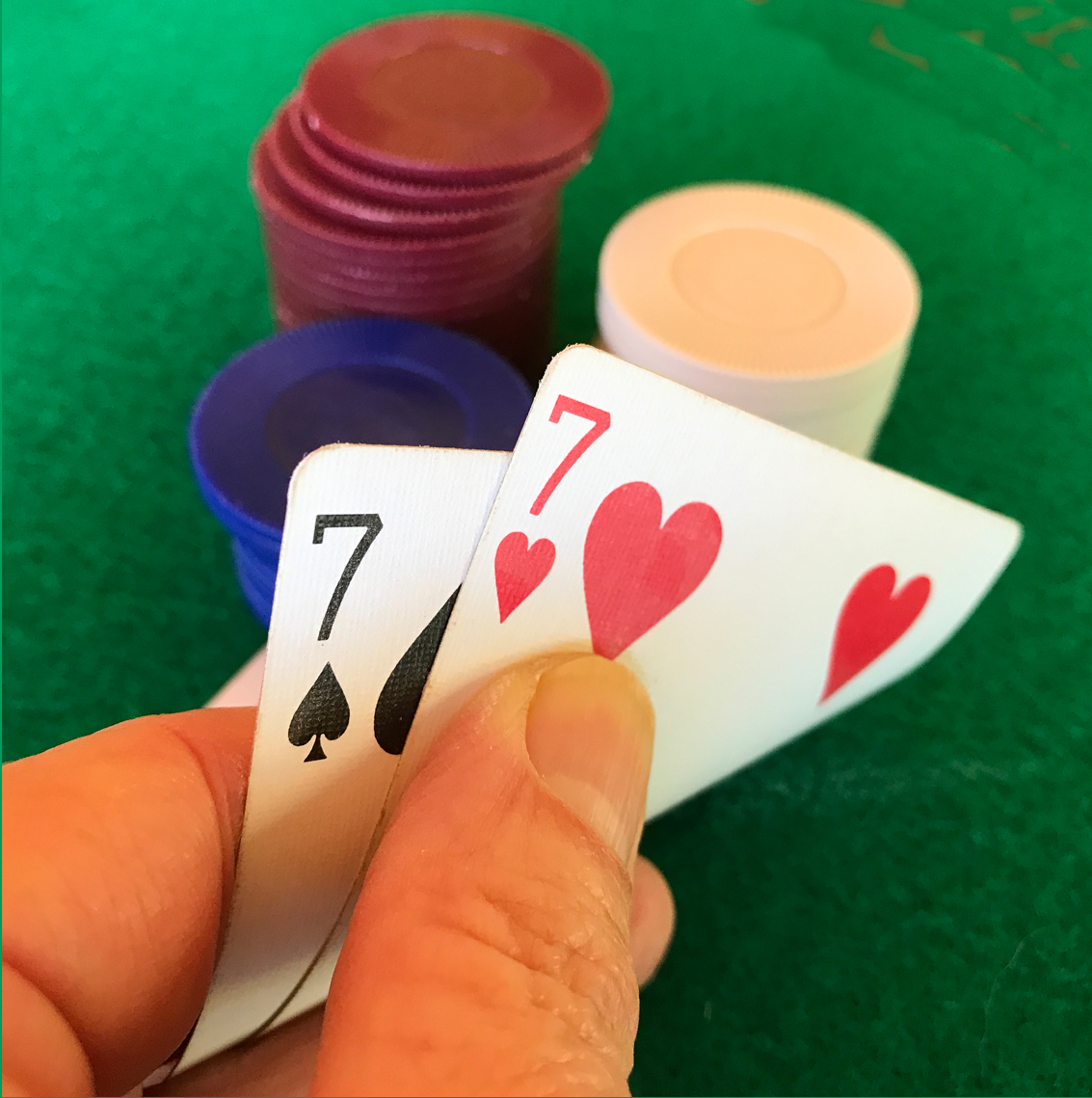
INSPIRATION: What could I paint that would include two sevens? Playing cards came to mind. I am a game buff and know Black Jack so I pulled out a deck of cards, some old poker chips and a piece of green felt and photographed my own hand with them, shown above. Two 7’s add to 14 which happens to be my lucky number and I picked the heart as one card - both echoing my wedding date of Valentine’s Day on Feb. 14th (which will be our 50th anniversary in 2026).
REFERENCE: My own still life set-up, with my hand holding cards with stacks of old poker chips, all on a piece of green felt. I love games and play lots of different card games, including poker and black jack. I used the 7 of hearts, since 7 plus 7 = 14, my lucky number - I was married on Valentine’s Day, February 14th, celebrating 50 years with my best friend in 2026. - The Godfather, a cocktail made from Scotch and Amaretto
- painted with Famous Grouse Scotch
INSPIRATION: Rick is a fan of the three Godfather movies and often quotes them. Still I struggled to find one image to represent this cocktail. I thought about a portrait of Marlon Brando as Vito Corleone, a gangster kissing his ring, and other movie clips. My final image comes from the movie quote “Leave the gun, take the cannollis,” and this one was my favorite in this series to paint.
REFERENCE: I used online photos of bakery boxes, cannollis and a snub-nosed 38 revolver (commonly used by gangsters) to compose my reference. - Manhattan, a cocktail made with rye whiskey, sweet vermouth, and bitters
- painted with New Riff Rye
INSPIRATION: I am a country girl, although I have been to NYC a few times in years past. This image is the one I painted twice! I chose New Riff whiskey, since Rick had visited their Kentucky distillery years ago when attending an event presented there for attendees at a convention in Cincinnati OH. This was as close as either of us were to Manhattan in recent times, and one of the only bottles of rye in our liquor cabinet. I struggled with what imagery would most strongly suggest “Manhattan,” considering street scenes like Broadway or Times Square, view of the skyline from different locations, Central Park, street signs for Wall Street, etc. A simple skyline seemed best, and the foreground items in the water added interest, as did the colorful sunset.
REFERENCES: Various stock photos.
By the way, painting with whiskey vs. water didn't differ much. The alcohol evaporated faster than water, on the palette and on the paper, but didn't yellow my hues. Working with watercolors in miniature made my passion for details a bit challenging, but I survived the test. Now I am creating two more small whiskey-color paintings to present with my WPA membership request, and I've chosen some unique subjects.
I hope you had as much fun with this post as I had creating the series of cocktail whiskey-colors... and maybe learned a thing or two about whiskey too!